
 Byron Martin
Leadership Beyond the Office: Dr. Jeremiah Hawkins on Identity, Trust & AI
 Byron Martin: Jul 28, 2026
Every profession shapes us. The best leaders make sure it doesn't define them.
It's Monday morning. You walk into the office with a plan. This is the week things move forward.
Then, almost immediately, something interrupts it.
The printer stalls. Someone in accounting is locked out of QuickBooks because the verification code is going to an unknown phone number. A client email hasn’t been seen yet because Outlook has been “syncing” for the last half hour. The Wi-Fi drops at exactly the wrong moment. None of it is dramatic. Nothing is completely down. But somehow, it's enough.
You look up, and it's nearly 10 a.m.
And you haven't moved the business forward at all.
That moment, that stall at the start of the day, is more important than it looks.
Because for many businesses, this isn’t an exception. It’s a pattern. And it's costing you more than you realize.
It's not just your morning. It's everyone's.
While you were troubleshooting the printer, your office manager spent 30 minutes on the same problem. Accounting lost close to an hour working around the login issue. Two employees quietly switched to their phones when the Wi-Fi dropped because waiting wasn't an option. A client callback got missed because email wasn't cooperating.
That's not a technology strategy. That's coping.
Most businesses don't experience dramatic tech failures. What they experience is smaller, daily friction that everyone has quietly learned to absorb.
But consider this: if you have eight employees and each one loses just 20 minutes a day to technology friction, that's more than 800 hours a year quietly disappearing from your business. Not a crisis. Not a headline. Just a slow leak, and slow leaks are harder to spot than broken pipes.
That's capacity your business never got to use. Time that didn't go toward serving clients, closing deals, or growing revenue.
Most organizations don't feel like they have a technology problem. Systems log in. Files sync. Emails send. Nothing is technically down.
So nothing feels urgent.
But that's exactly how the real problem stays invisible, not in breakdowns, but in slowdowns.
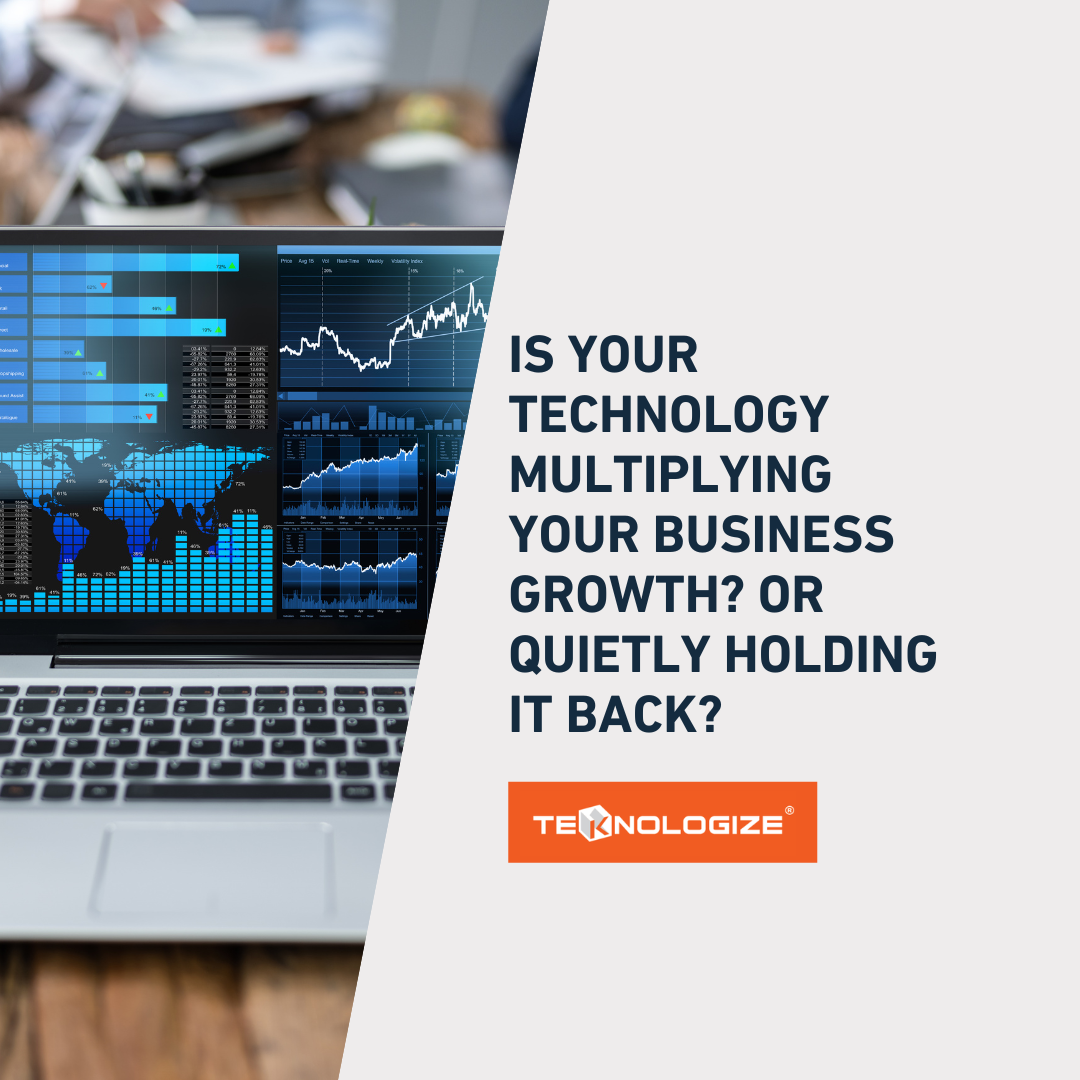
The better question isn't whether your technology works. It's whether your technology is contributing to your growth or quietly limiting it.
When we talk with business owners across the Pacific Northwest, most fall into one of three categories:
Technology helps us grow and make money. Systems are aligned with how the business operates. Teams move faster, make decisions with confidence, and spend their time on work that matters. Technology creates capacity instead of consuming it.
Technology keeps the lights on. Everything works, but nothing is optimized. The business runs, but it takes more effort and more energy than it should. Technology isn't actively holding things back, but it isn't contributing to growth either.
Technology holds us back. Friction is constant and visible. Teams have learned to work around their systems rather than with them. Growth isn't being limited by people or market conditions; it's being limited by misaligned technology.
If your business is in category two or three, you're not getting the return you should be on your technology investment. And your competitors may be pulling ahead.
Nobody sets out to build an inefficient system.
Most businesses make reasonable decisions along the way. A CRM gets added when client tracking becomes unmanageable. QuickBooks replaced the spreadsheets when those got out of hand. A new printer arrived when the old one died. The Wi-Fi router got set up years ago and hasn't been touched since.
Every decision made sense at the time. But nobody ever stepped back to ask whether it all works together, whether the pieces support each other, and whether the whole environment supports the way the business actually operates and where it's headed.
Technology that gets accumulated keeps the lights on. Technology that gets designed moves the business forward.
It’s not more software. It’s not more features. It's not a detailed explanation of what a firewall does.
What business owners actually want is to walk in on Monday morning and not think about technology at all.
They want the systems to work. They want their team to have somewhere else to take the problem when they don't. They want someone proactive, someone who calls before things break, not after. They want to focus on the work they actually built this business to do.
More specifically, they want:
The best technology doesn't just keep things running. It actively creates room for the business to grow.
When systems are aligned with the business, the difference is immediate and noticeable.
Work flows instead of stalls. Decisions happen faster. Teams spend less time navigating systems and more time producing results. The background noise fades, and with it, the constant friction that once felt unavoidable.
Capacity expands without adding headcount. Risk decreases because processes are clearer and more controlled. Growth becomes easier, not because the business has changed, but because the systems finally support it.
This is what most businesses assume they already have.
Until they experience what it actually feels like.
Answer these honestly:
If you answered yes to the first two and no to the third, your technology may be helping your business cope rather than helping it grow.
At Teknologize, the starting point isn’t technology. It’s your business.
How work actually happens. Where time is being lost. Where friction exists. Where opportunities are being limited without anyone fully seeing it.
Only then does technology enter the conversation, not as a set of tools to manage, but as something to align with how the business operates and where it wants to go.
We work with businesses across the Pacific Northwest as a strategic IT partner, not an IT vendor. Our goal isn't to fix what breaks. It's to help you grow, reduce risk, operate more efficiently, and adopt emerging technology, including AI, with confidence.
Because better technology, on its own, doesn't change a business. Better business performance does.
Technology should run quietly in the background. You should walk in on Monday thinking about strategy, revenue, and growth, not routers, restarts, and printer issues.
In many cases, the biggest barrier to growth isn’t something that’s broken. It’s something that’s been tolerated for too long.
A delay here. A workaround there. A system that “mostly works.” Individually, they don’t feel significant. Together, they define how far, and how fast, a business can go.
And once you see that clearly, the question changes.
It’s no longer, “Is our technology working?”
It’s:
“Is our technology helping us grow, or is it quietly holding us back?”
You built this business to do what you're great at. It's time your technology made that easier, not harder.
What does "technology alignment" mean for a small or mid-sized business?
Technology alignment means your systems, tools, and processes are working together in a way that supports how your team actually works, and where your business is headed. When technology is aligned, it reduces friction, creates capacity, and contributes directly to growth. When it's misaligned, it quietly drains time and limits what your team can accomplish, even when nothing appears broken.
How do I know if my technology is helping or hurting my business growth?
A few questions worth asking: Does your team spend time working around systems rather than with them? Are manual or redundant tasks eating up hours that should go toward serving clients? Do you feel confident your technology could scale with you if your business grew 20% in the next year? If the answer to any of these is uncertain, a technology alignment audit is a good place to start.
What's the ROI of investing in better business technology?
ROI on technology investments varies, but the clearest gains usually come from time recovered, risk reduced, and growth enabled. Organizations that move from reactive IT to strategic IT alignment often reclaim significant team capacity, time that was previously lost to friction, workarounds, and inefficiency, and redirect it toward revenue-generating work.
How does Teknologize approach cybersecurity and compliance for regulated industries like healthcare?
Cybersecurity and compliance aren't add-ons for us, they're foundational to how we serve every client, and especially critical for businesses operating in regulated environments like healthcare, financial services, and government contracting. For organizations subject to HIPAA, FTC Safeguards, CMMC, or similar frameworks, the stakes of misaligned technology go well beyond lost productivity; a breach or compliance failure can threaten the business itself. We approach cybersecurity as a business risk management priority, not an IT checkbox, helping regulated organizations build systems that protect their clients, satisfy their compliance obligations, and still support growth and operational efficiency.

 Teknologize is a SOC 2 Type I accredited Managed IT and Cybersecurity provider serving small to mid-sized businesses across Washington and Oregon. We deliver full-service Managed IT Support, Co-Managed IT Support, advanced Cybersecurity Solutions, and IT Compliance Services for regulated industries, including Healthcare, Financial Institutions, the Utilities Sector, Manufacturing, and Professional Services.
👉 Book a Discovery Call to see how Teknologize can support your business.
Our Offices
Tri-Cities, Washington – 509.396.6640 | Yakima, Washington – 509.396.6640
Bend, Oregon – 541.848.6072 | Seattle, Washington – 206.743.0981
Questions about your IT or Cybersecurity? Give us a call today!
 Byron Martin: Jul 28, 2026
Every profession shapes us. The best leaders make sure it doesn't define them.
 Byron Martin: Jul 16, 2026
For years, budgeting for business computers was fairly predictable. You could estimate replacement costs, plan refresh cycles, and expect only modest...
 Byron Martin: Jun 18, 2026
Healthcare costs continue to rise. Insurance premiums keep climbing. And now artificial intelligence is rapidly changing how healthcare providers,...